In the Empty Rooms of History, the Hare Carries Time
As it happens when you spend enough time with a text, sooner or later the text begins to read you.
Between eight and half past eleven each morning, I sat in my studio writing. A few days had passed since my arrival, and I had settled into the body's rhythm of the studio. The windows, with their peculiar latches, demanded a certain finesse to open and close, and the door lock obeyed a logic entirely of its own. The upper lock required a quick inward push of the handle before turning once to the right; the lower one needed two turns in the opposite direction. After a few days, I had begun to understand the room's habits.
Every day, just before lunch, I stepped out onto Rue de Belleville and was immediately met by the cacophony that only a large city can produce. One step into the current of the streets, and the text began translating into my body whatever my eyes, nose, hands, and the soles of my feet encountered. The anxiety had subsided. It was as though it had grown arms and legs and could now move through the city instead of remaining trapped inside me. Every point my eye settled on became another handhold on a climbing wall, carrying me forward toward the Asian quarter in search of something to eat.
I have always believed that movement should be uncomplicated. Before I left, the artist Thomas Hallon Hallbert told me that one does not need much for a journey like this. A small notebook is enough. I agreed.
I wrote while I ate. So absorbed was I in my thoughts that I failed to notice I had put an entire chili pepper into my mouth. The moment I bit into it, the heat exploded.
I began sweating instantly. My eyes lost their point of focus and turned inward, toward the automatic mechanics that take over when the body's natural harmony is suddenly disrupted. In the middle of the burning sensation, I found myself thinking about the fetus. Could it feel this? Could it sense the walls of my body tightening around it? I cooled my mouth with water and rice, wiped the sweat from my upper lip, and cautiously resumed my meal.
When the inner self becomes destabilised, the body reaches for external points of orientation. The city became a kind of external nervous system. The traffic, the people, the sounds, the smells, they lent me structure. But they were shaping me, too. I thought of Karen Barad's concept of intra-action: that we never simply move through the world as separate subjects but are continuously constituted through our relations with it.
The blister beneath my right foot had begun to shape the way I walked. Because of my growing belly, I already waddled slightly forward; now I twisted my body even further to avoid irritating the wound. The walk toward Montmartre became a peculiar exercise in moving freely, efficiently, and yet with constant restraint. In certain neighbourhoods the traffic thickened, and my body instinctively tensed so as not to fall out of joint with the city's anatomy.
Pregnancy had made bodily evident something that had always been true: we are always traversed by other bodies.
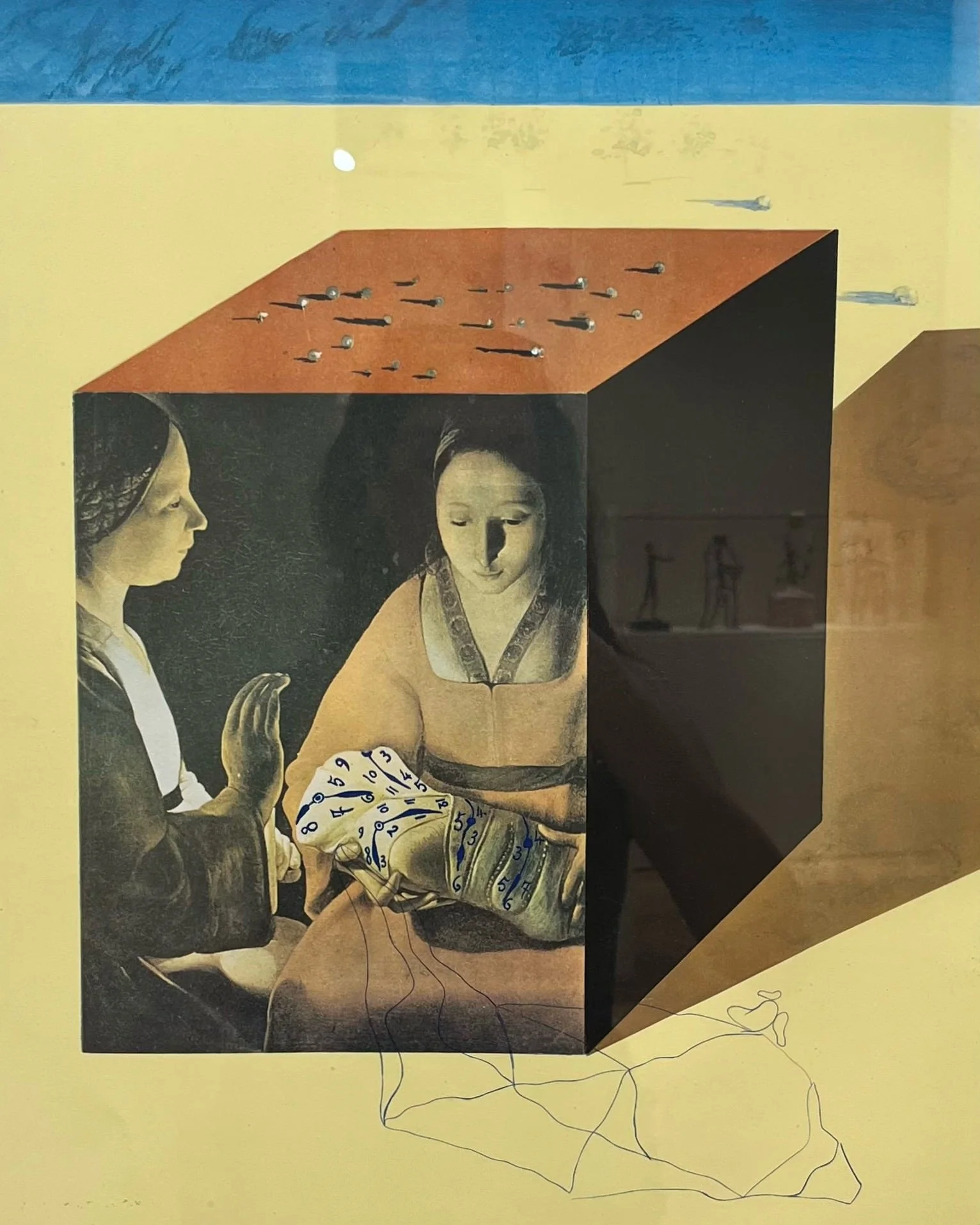
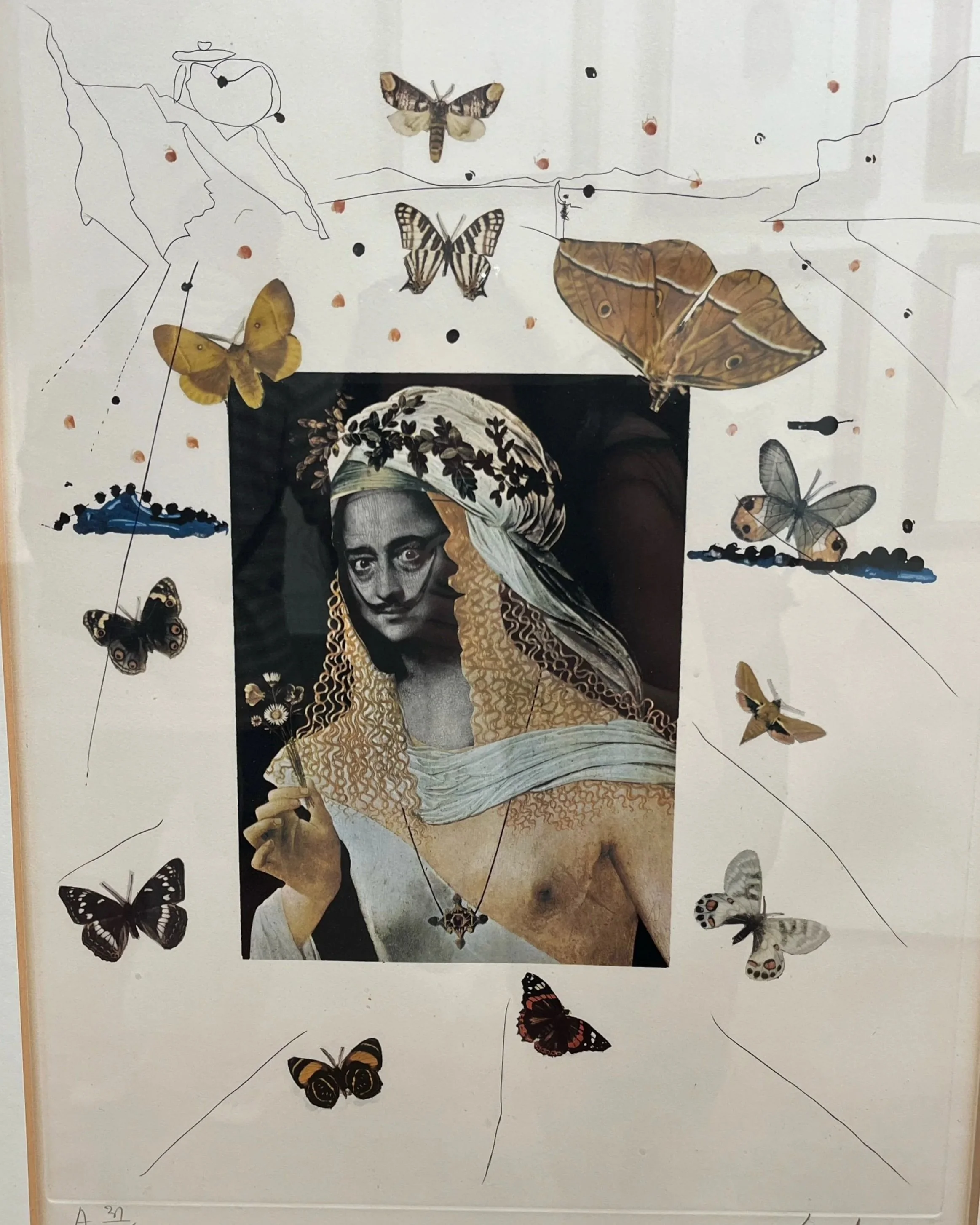
Perched high on a hill in Montmartre stood the Dalí Museum. I had always admired Dalí, especially his drawings. His surrealist objects were meant to honour thought itself, liberating the subject from the constraints of reality. He was obsessed with death, determined to overcome it and become the artist of immortality.
Yet there I stood, in my warm, limping, pregnant body, strangely unmoved. Dalí had suddenly become, for me, a symbol of an older philosophical dream: to transcend the body, time, and death. Pregnancy, by contrast, had compelled me to surrender to time rather than master it.
Toward the end of the week, the temperature climbed to thirty-five degrees Celsius. My partner had arrived, and together we travelled to Versailles.
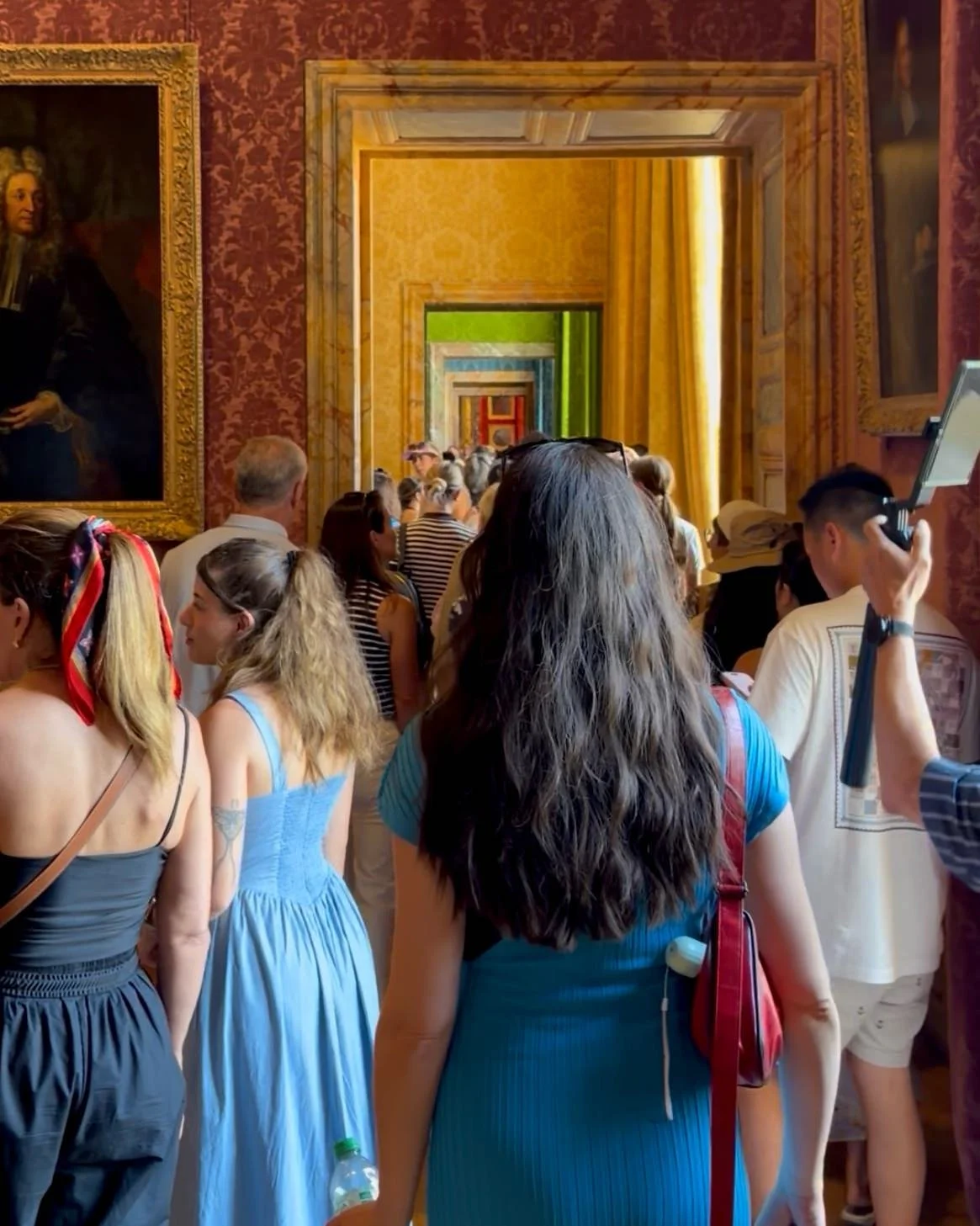
The palace was built to impress. Room after room unfolded into the next. Empty, save for paintings lining the walls. We passed the King's bedroom, then the Queen's, before arriving at a room devoted to Napoleon. Versailles speaks the language of power, order, history, and representation. It is an architecture of control. Yet what I found most pleasurable was passing through the doorless rooms. They felt almost uterine. And yet strangely hollow.
Versailles embodies hierarchy, ceremony, and stable boundaries. But what I carried within me dissolved precisely those boundaries. We had travelled from the pulse of the city into the empty rooms of history.
History has often treated the pregnant body as an object of knowledge, but far less often as a subject of thought. We have learned a great deal about pregnancy, yet thought remarkably little from it. That difference matters.
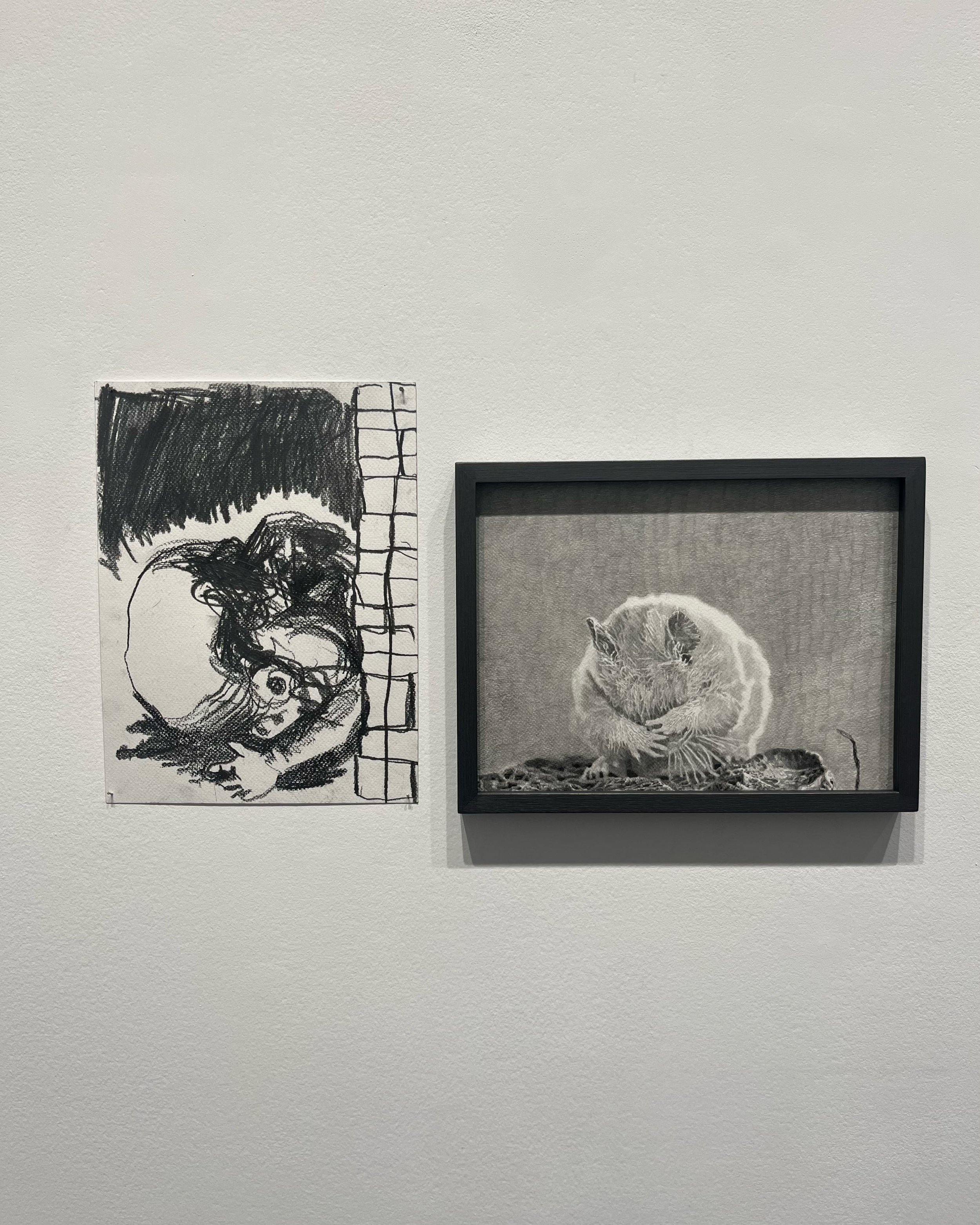
Travelling with me was Aase Berg's Forsla fett (Transporting Fat). Her poetry portrays the body as strange, unruly, and impossible to fully domesticate. Certain animals return again and again: the hare and the whale. Yet it is never entirely clear who is speaking: the mother, the child, or the fetus. Whose body is this? And who is the unborn?
In Of Woman Born, Adrienne Rich writes that rational thought casts whatever it cannot assimilate into its opposite. Berg's language seems to resist precisely this gesture. She refuses to write: I feel X because of Y.
Instead, she writes how the body experiences the world. There are no fixed subjects. The hare becomes the mother, the fetus, the animal, instinct, fear. Rich describes the fetus as "something inside and of me, yet becoming hourly and daily more separate." It is that small word and that also lives in Berg's poetry. Relation precedes separation.
Pregnancy reminds us that the two cannot yet be disentangled, not because they are identical, but because they still share matter. Berg shows that language itself must become porous if it is to speak of such an experience.
In my own experience, I am neither one nor two. Not entirely a mother, not entirely my former self. Somewhere within Berg's “shimmering tunnel interiors”, I come into being. I am the process itself, the ongoing experience of living with something that has entered me and is changing me.
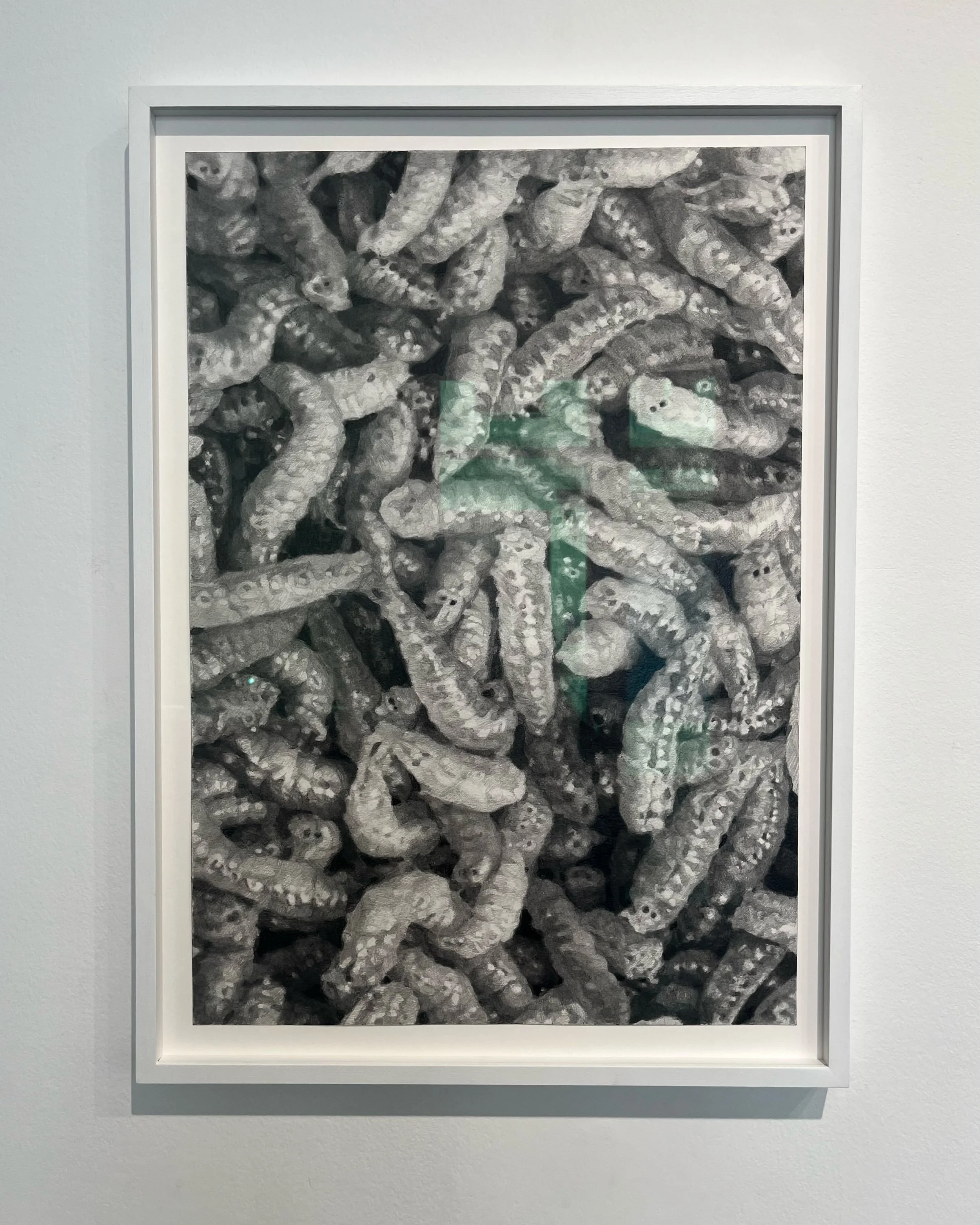
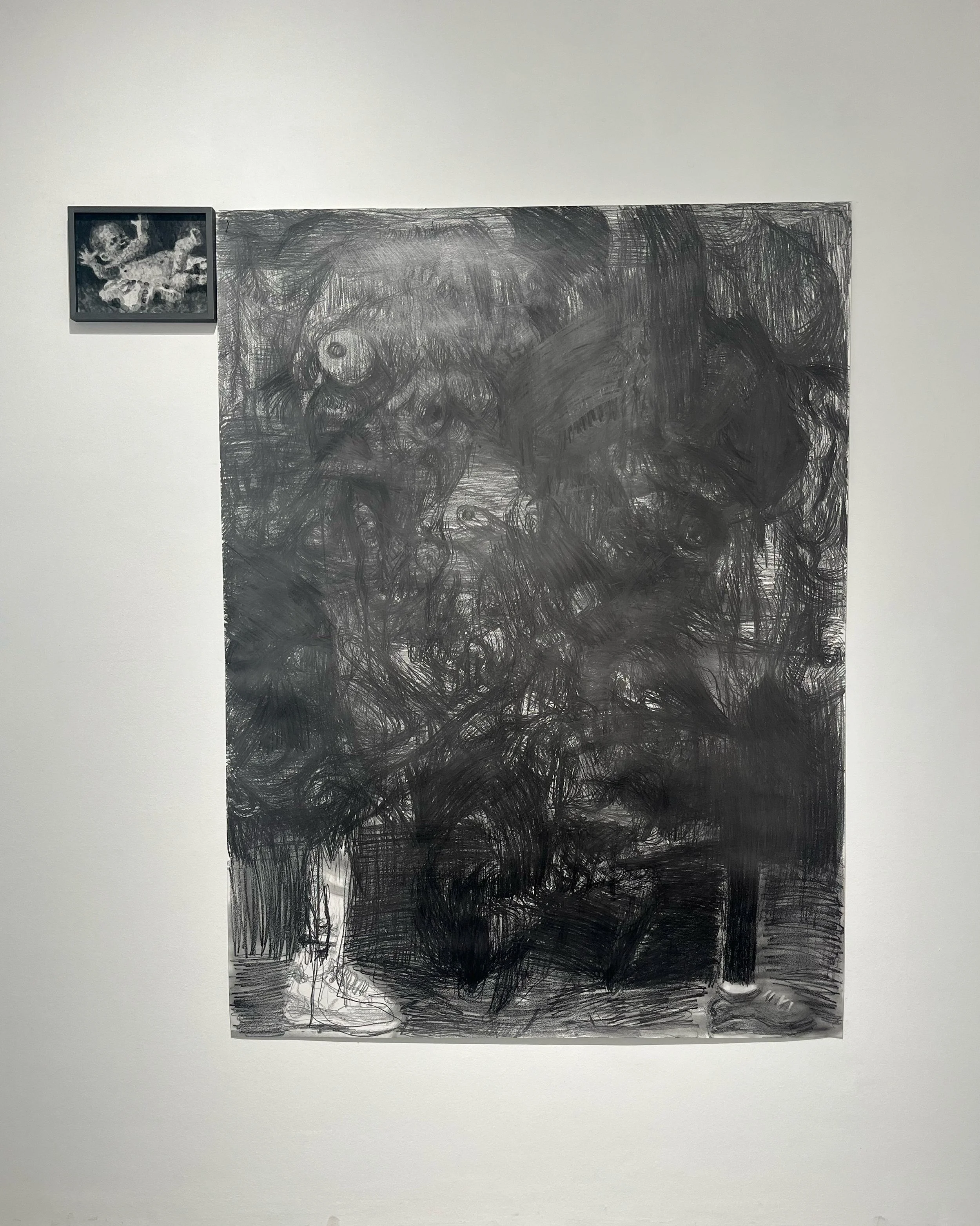
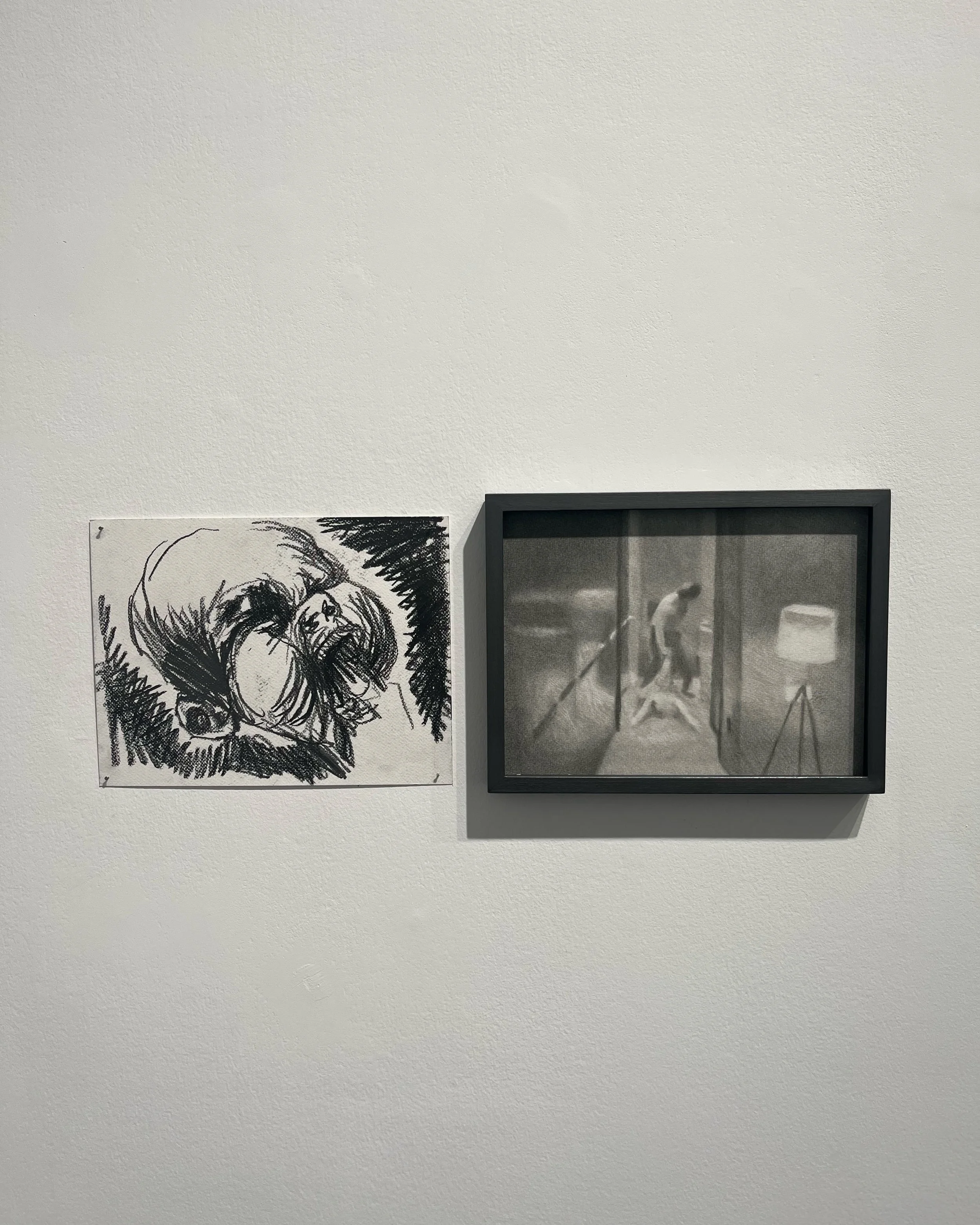
Midway through the week, a drawing of larvae drew me into another gallery. Jérôme Zonder was exhibiting Portraits du paradis. I found myself lingering before the portraits, the infants, the weeping faces, and the insects. All assembled within the same visual universe. The figure who carries these images is sustained by the very material from which it is made. Zonder seems to be saying: Here is the process that happens, for a while, to be called a person.
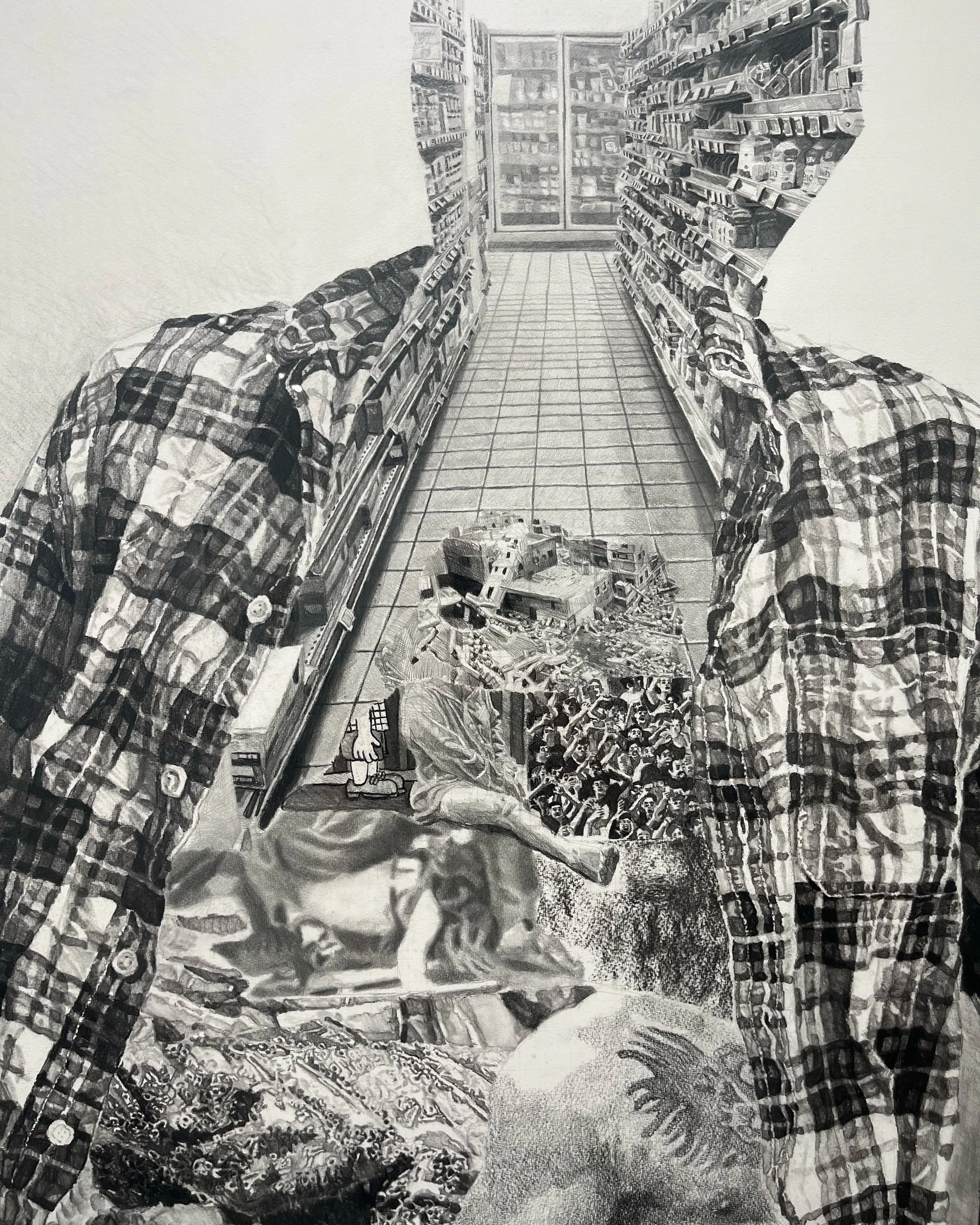
Here, the human being is no longer understood as a unified figure, but as a montage of memories, images, and forces.
My father once told me that his memories are his house. Without them, he would fall apart. My own memories and thoughts settle inside me. I rearrange them; they unsettle me, strengthen me, and exhaust me. If a person today consists of thousands of images, memories, and streams of information, then where, exactly, is the person?
Memory is not a shelf. It is a montage. That is why I need images. The astronaut, the oyster, the larvae and the hare. They are not illustrations of thought; they are thought itself.
Berg and Zonder both reveal a permeable body. Their images become provisional organs of thinking. Dalí wanted to leave the body behind, Berg and Zonder move directly into it. When experience precedes language, the image arrives first. This is perhaps what it means to think phenomenologically: one does not think about the image, but through it.
We usually say that the artist creates the image. But sometimes the opposite is true. The line unfolds the artist. The mother creates the child, the child creates the mother. Just as the city through which we walk quietly shapes us in return. In Paris, the question gradually shifted from Who am I? to How do I become?
Had society been shaped around pregnancy rather than the autonomous individual, much might have looked different. Pregnancy reminds us that life does not emerge through autonomy but through radical dependence. Dependence is neither failure nor exception, it is the condition from which life begins.
Perhaps we would have been less preoccupied with control, independence, and productivity, and more attentive to care, waiting, and the forms of labour that unfold quietly in the background. Much of the work that has sustained life throughout history, like pregnancy, breastfeeding, raising children, caring for the elderly and maintaining a household, shares the same structure: repetitive, slow, indispensable, and yet almost invisible. Care would not have become a "women's issue," something set apart from real life. It would have been recognised as one of its foundations.
It would also transform how we think about the environment, animals, family, and society. Rather than moral obligations toward something outside ourselves, they would become expressions of an interwoven existence. Pregnancy makes this especially visible. We are composed of temporary assemblages, partial separations, and forms that share matter without sharing identity. We might become a little less certain of where our own boundaries end, and more willing to recognise that others, too, are always unfolding in ways we cannot fully see.
It might also reshape our understanding of ethics, not as something that begins once we identify another individual and rationally determine what we owe them, but as something that grows out of bodily proximity, affect, and dependence. The ethical relation precedes separation.
Pregnancy is therefore not only something that concerns the pregnant person. It reveals something about all of us: that boundaries are never absolute, but always depend on how we sustain them.
During my stay in Paris, I read Is Pregnancy a Disease? A Normative Approach by Anna Smajdor and Joona Räsänen, an article that poses the metaphysically intriguing question of whether pregnancy might be understood as a disease. The authors do not argue that pregnancy is a disease. Rather, they use the thought experiment to expose contradictions in how pregnancy and women's health are understood. Pregnancy is already highly medicalised and subject to extensive surveillance, largely centred on the fetus, yet the pregnant woman's own body is not always fully recognised as the patient. The fetus is readily granted patient status, while the woman herself is often expected to endure levels of pain and suffering that, in other medical contexts, would demand immediate treatment.
At the same time, the social expectation that women should want to have children is so deeply ingrained that it becomes difficult even to imagine pregnancy as a disease-like condition. The question, then, is less about medicine than about which experiences our social norms allow us to perceive.
The authors also point out that the risk of dying from pregnancy-related causes remains significantly higher than the risk of dying from measles in countries with effective vaccination programmes, while those risks increase dramatically where women's rights and autonomy are less protected. Pregnancy thus emerges not merely as a biological process, but as a political and social one.
They further remind us that the concept of disease has never been neutral. What counts as disease has always been shaped by historical and cultural values. Diagnoses such as hysteria, immorality, homosexuality, and even drapetomania (the so-called "disease" that supposedly caused enslaved people to flee captivity) were once accepted as legitimate medical conditions. The question, therefore, is not simply what a disease is, but who has the authority to decide. Marginalised groups are often pressured to understand their experiences according to prevailing social norms. Just as the expectation that people ought to have children contributes to infertility being understood as a disease, the same expectation makes it difficult to recognise pregnancy as sharing disease-like features.
It exposes yet another empty room in women's history: that what has carried human life forward has long been considered natural enough to endure, yet not important enough to be taken fully seriously.
I both left and remained in Paris on the day of my departure. An unexpected train delay, a misunderstanding about our flight time, and the haste that followed meant that my partner and I, in thirty-degree heat and with only a limited grasp of French, accidentally left one of our suitcases on the train. The moment it pulled away and we realised the suitcase was continuing without us, I hurried over to the station staff to explain what had happened. Five French people joined together in a resounding "Oh là là!", wearing expressions that seemed to say I would probably never see that suitcase again.
It now belonged to another system, another orbit, remaining within the body of the city.
I said goodbye to it in my thoughts while eating the last blueberries from the punnet before we boarded our flight home. In the end, it did not matter very much. In just a few days we would learn a little more about the one growing inside me, and that anticipation soon surpassed the material loss.
The hare, having opened a room of its own within my body, kicked its presence into being and took up more and more space. Now it was we who were eating. And we happen to like blueberries best.