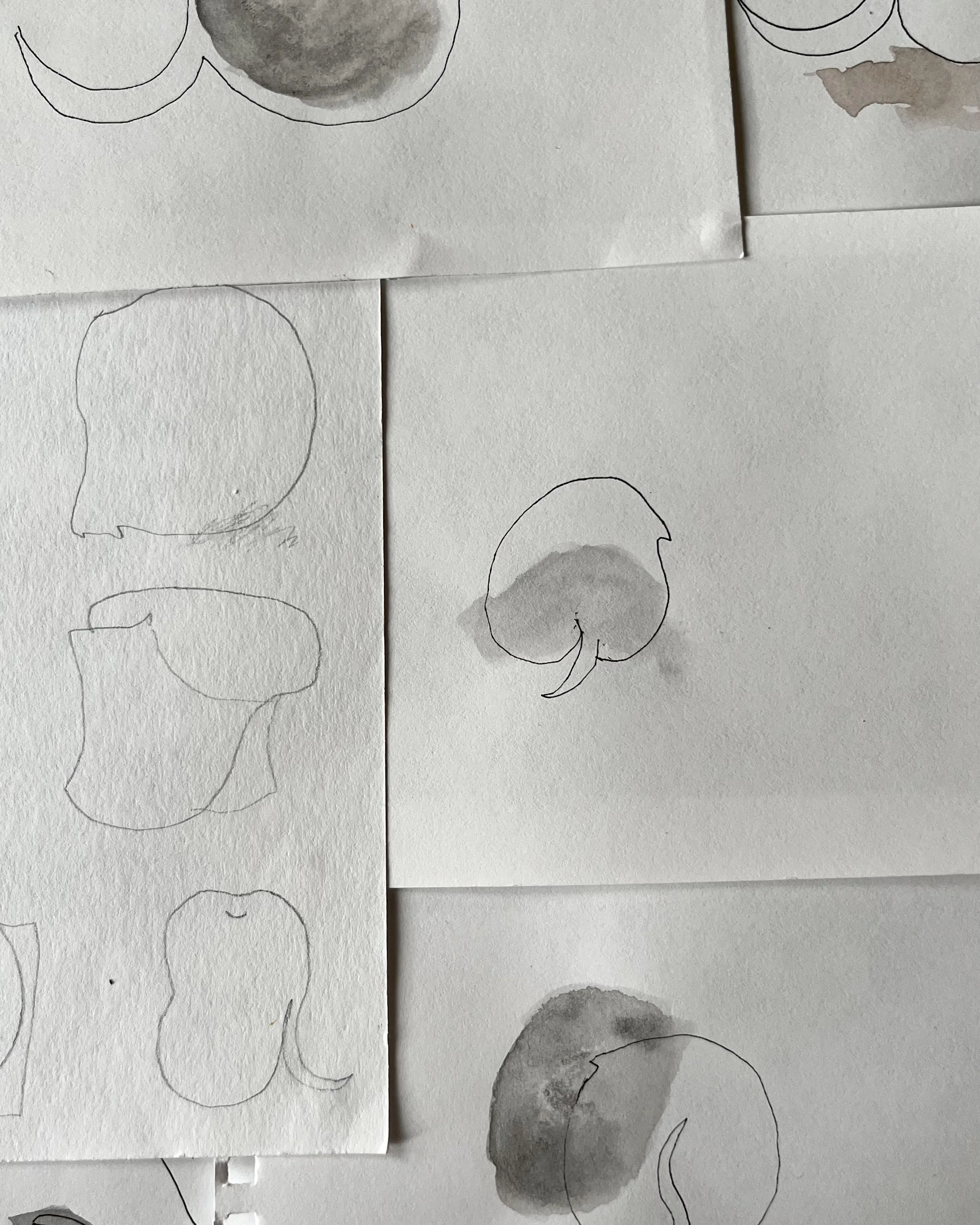
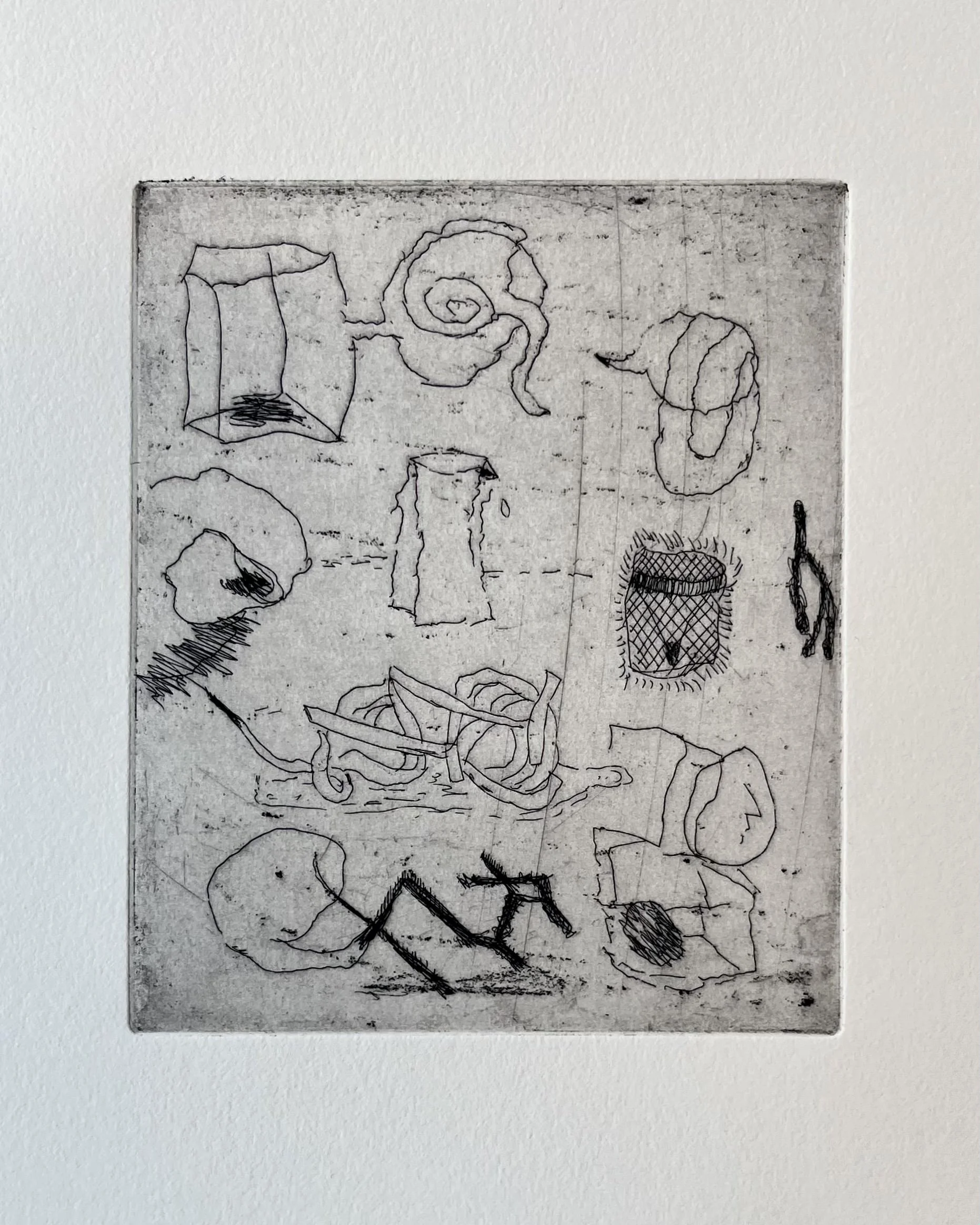
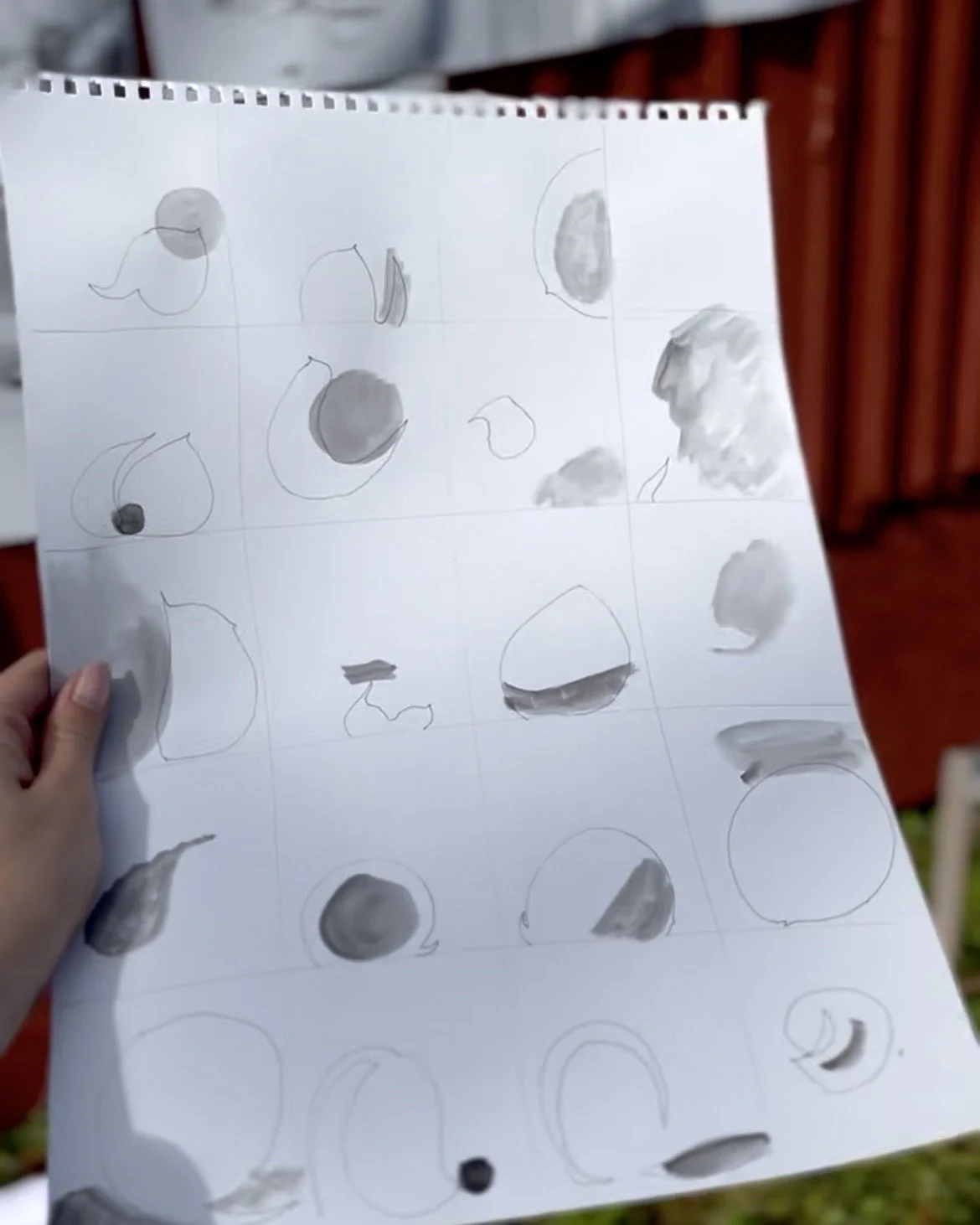
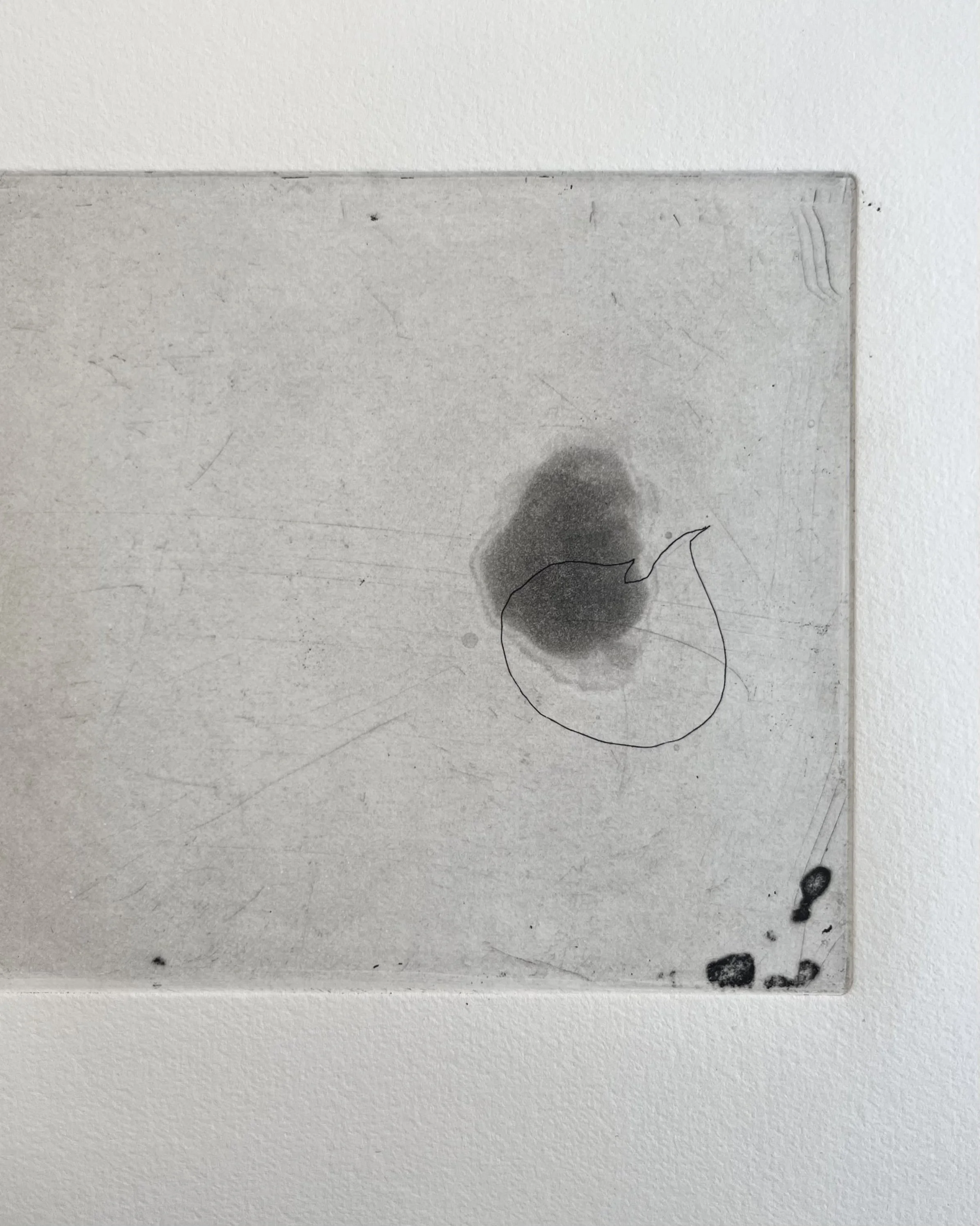
Does It Start Like a Tail and End Like a Yoghurt?
Philosopher Elselijn Kingma casts our metaphors in a different light when, in a lecture on the metaphysics of pregnancy, she considers the familiar expression “to have a bun in the oven” alongside another metaphor: a yoghurt in a fridge. In both images, the pregnant woman becomes a kind of container for something and, as a consequence, remains relatively unchanged by the yoghurt or bun she contains. Kingma invites us to consider the opposite as well: the fetus as part of the pregnant woman. This produces a different image, the image of a tail.
The metamorphosis that pregnancy entails, the biological exchange and sharing between the pregnant woman and the fetus, disrupts the image of a container. As Iris Young describes it, the fetus is something she experiences as part of herself, but hourly becomes increasingly separate. The image gives rise to new images and new questions, and at the end of the lecture someone in the audience asks: Does it start as a tail and end like a yoghurt?
The lecture ends without arriving at a definitive metaphor, and perhaps in doing so reveals its purpose. The peculiar question itself exposes the limits of thought and our need to use images in an attempt to understand existential experiences. Without settling on either yoghurt or tail, I cannot help thinking that Kingma’s argument draws attention to both the power and the inadequacy of images, and to how our ideas have traditionally been so dualistic in character that we rarely notice what might exist between yoghurt and tail.
In philosophical discussions of pregnancy, the image of the fetus has largely been a question of either one thing or the other. Philosophical traditions have left little room for what lies in between. Kingma describes how the container metaphor has had consequences for science and medicine, and for how we treat both the fetus and the pregnant woman.
What does it mean to be part of something and at the same time an independent part? Is the pregnant body a body that has changed, or a body containing someone else? Does the fetus begin as something understood as part of me, only gradually to become someone within me? When, if ever, does the shift from one to the other occur? To explore this further, we need to take a closer look at both the yoghurt and the tail.
A tail is of the body. It does not sit inside the body like a separate object. If you step on a cat’s tail, you step on the cat. The yoghurt sits in a fridge. Alternatively, we might imagine it inside its own container or pot. The pot, or the fridge, and the yoghurt have two clearly distinct identities. You can pour out the yoghurt and the pot remains a pot. You can take the yoghurt out of the fridge and the fridge remains a fridge.
Early in my pregnancy, I remember very clearly being consumed by a profound crisis of identity. The image of myself that appeared in my mind’s eye had no definite shape. It looked more like a process, colours and forms floating around, impossible to capture or solidify into a finished image. It was as though I were watching the cell division taking place inside me. The day I learned the sex of the fetus, the image became somewhat more fixed, while at the same time a clearer separation appeared. Was that roughly when the fetus became someone else?
The container model as a metaphor turns something that is not yet quite two into two individuals, and as a metaphor it is not entirely innocent either. The container model is not merely a poor description. It can also produce a particular kind of pregnant woman. Someone whose body has become an environment, whose actions are judged according to the interests of another individual, and whose own needs can therefore more easily be perceived as competing with those of the fetus. The tail would probably produce different intuitions.
With two clearly defined entities, it becomes easy, for example, to think in terms of the interests of the fetus versus the interests of the woman, the rights of the fetus versus the rights of the woman. Within the container model, the woman is judged according to the environment she provides. Food, exercise, alcohol, medication, stress and behaviour are evaluated according to how well that environment takes care of its contents.
The problem arises when we begin with already defined entities and then attempt to describe the relationship between them, even though the relationship itself participates in producing what those entities are becoming. The pregnant body is not merely a container for a relationship. The relationship changes what the bodies themselves are and what they will become.
The separation between the pregnant woman and the fetus takes place on different levels and at different speeds. The fetus and the pregnant woman share a physiological system in which oxygen and nutrients are exchanged through the placenta and cells can pass between their bodies. They continue to share cells years after the child is born. And the pregnant woman’s brain has been changed for good.
We usually ask when the child is born, but when are two actually born? When do one and something more than one become two? And what happens if we do not try to solve the problem and settle on neither tail nor yoghurt?
Philosopher Fiona Woollard describes pregnancy as something of a residual case for philosophical categories, and not without consequences. How we imagine this relationship affects the moral conclusions we draw.
Woollard argues that pregnancy can be an “epistemically transformative experience”. The experience can therefore provide access to knowledge that is very difficult to acquire without having been pregnant oneself. Her point is that philosophical methods need to change when relevant knowledge is not equally accessible to everyone. She emphasises the importance of taking personal accounts and literature more seriously.
The way we understand pregnancy and the images we produce affect both the philosophy of abortion and the ways philosophers conduct research. The invisibility of pregnancy can produce philosophical mistakes with practical consequences. Pregnancy challenges traditional philosophical ideas about morality and knowledge, birth and early motherhood. And philosophical mistakes concerning the mother can contribute to harmful treatment of pregnant women and mothers.
Through my own experience, and the questions it has brought about, I now find myself between two questions: Which metaphor best describes pregnancy? And what do our metaphors actually do to our experiences?
In a debate between the philosophers Elselijn Kingma and Berit Brogaard, Brogaard largely defends the traditional view that pregnancy involves two organisms. Brogaard draws on biological criteria such as genetic development, self organised growth and the embryo developing its own bodily organisation relatively early. According to her, a new organism comes into existence very early in embryonic development. The mother functions as a living environment and source of nutrition. The fetus, she argues, is not part of her body in the same way that, for example, a kidney is.
Kingma argues that this model only appears self-evident because we are accustomed to it. She suggests that almost all images of pregnancy are based on this assumption. Medical illustrations and images in popular culture also tend to depict the fetus as an almost independent “little baby”, while playing down the placenta, the umbilical cord and the physical entanglement between them. There is no clear physical boundary between mother, placenta and fetus, Kingma argues. The system is enormously integrated.
Kingma allows us to take seriously the possibility that the fetus during pregnancy is actually part of the pregnant organism, much as other bodily parts are parts of an organism, although a very particular kind of part. This forces us to reconsider what we mean by an organism.
The question of whether it is a tail or a yoghurt, or perhaps a tail that becomes a yoghurt, also reveals something about how we think. When we do not know how something should be understood, we begin to create images in order to be able to think. When concepts are simply no longer sufficient, an image is born. And perhaps more importantly, we discover that images do not merely represent understanding. They also produce understanding.
I also cannot help wondering whether the container model protects us from something we might not want to see, complicate or make visible. Kingma’s argument reveals that philosophy is already thinking through an image, seemingly without noticing it. Images always do two things at once: they reveal and they conceal.
A more open position might be to acknowledge that we do not yet even know how to describe the relationship.
The container model is a practical image. It makes pregnancy comprehensible because we know what a container is. We understand what it means for something to be inside something else, and this provides order, clear boundaries, individuals, responsibility, law and medicine. At the same time, the model conceals the placenta. Where does it belong? To the mother or to the child? Neither, both, or something else entirely? And what happens to microchimerism, the phenomenon in which cells travel between mother and fetus and can remain for decades? The container model has no language for it. What happens to the immune system? It does not behave as it would between two entirely separate individuals. And what happens to the experience itself, in which many pregnant women describe a feeling of: I do not quite know where I end.
How are images born in the first place? When concepts collapse, the image begins to work. But images do not merely help us understand. They also determine which questions we are able to ask.
If we think in terms of a container, we ask when the fetus becomes independent, where the boundary lies and who owns the body. If we think in terms of an ecosystem, we ask how the relationship changes, how new functions emerge and how the whole organises itself. If pregnancy were instead described as a dance, for example, we might ask how movements are coordinated, how the bodies respond to one another and how the rhythm changes. The image does not merely produce answers. It produces the questions themselves.
What do our metaphysical images do to the world? Metaphors do not merely attempt to describe reality. They also organise institutions. If the woman is a container, pregnancy can easily become about what is inside the container rather than about the container itself. In practice, this can manifest itself in many ways.
Within healthcare, the fetus often becomes the primary patient. The baby’s growth and heart rate are measured. The pregnant woman’s experience risks becoming secondary because the system is organised around a particular focus.
This can be seen, among other things, in how pregnant women are expected to endure physical and psychological strains that, in someone who was not pregnant, might have prompted treatment or greater care. It can also be seen in how responsibility for the health of the fetus, and later the child, is placed to a great extent on the pregnant woman and subsequently the mother. She is expected to create the best possible conditions through what she eats, does, avoids and exposes herself to. Far less visible is the responsibility for the conditions surrounding her: how norms, economic structures, working conditions, healthcare systems and living environments affect her ability to meet these expectations in the first place. If the pregnant woman is made into the environment of the fetus, the question remains: who is responsible for hers?
This becomes particularly visible in how we understand the period surrounding birth. Parental leave often begins shortly before birth and continues through and after it. At the same time, giving birth can involve extensive medical care, severe pain, expected physical injury, sometimes surgery and several days in hospital, followed by a period of recovery involving bleeding, wound healing and pain. Despite this, we do not usually speak of the period following birth as sick leave or convalescence. It has already been given another name: “maternity leave”.
This reflects the container model remarkably well. Once the child has been born, attention immediately shifts towards parenthood and the baby, while the body that has just gone through birth easily disappears from the very language we use to describe this period.
If pregnancy were instead understood as a relationship or a shared physiological system, perhaps the questions would more often be: How are you changing? How is pregnancy affecting your entire organism? What do you need for this relationship to function well?
A historical extreme of this division between the woman and the fetus can be found in nineteenth century obstetrics. During a complicated birth, a doctor could be faced with a choice. At the time, a Caesarean section posed a very high risk to the woman’s life. In some cases, the fetus could instead be removed through what were known as destructive procedures, thereby saving the woman. The Catholic Church, however, opposed such procedures when the fetus was still alive, since they involved deliberately ending its life. Baptism and the idea of the child’s salvation also played a role. After the death of a pregnant woman, her body could be opened in an attempt to remove the fetus alive and make baptism possible. Once the woman is dead, her body appears as a container that must be opened in order to reach the other individual inside. The question of the separate interests of the woman and the fetus is therefore not merely philosophical. The ways in which the two bodies have been represented in relation to one another have also helped shape which lives could be understood as possible to save, and under what conditions.
The historical example is, of course, far removed from my own experience, but the division between the interests of two bodies suddenly became less abstract to me when, during my third trimester, I fractured my ankle in three places and needed surgery. The question of pain relief also became a question about the fetus. For several days I was in immense pain, while the possibilities for relieving it were limited. Paracetamol made no noticeable difference. I was also offered stronger pain medication, but was advised to take it only when I really needed it and preferably as little as possible. Every tablet therefore became a decision I had to make myself: How much pain do I have to be in for a possible risk to the fetus to be justified?
The caution surrounding what the medication might potentially do to the fetus simultaneously meant something very concrete for my own body which was pain. The lack of knowledge surrounding medication during pregnancy does not disappear simply because the more cautious option is chosen. Someone has to carry the uncertainty, and in this case it was carried by the pregnant body.
The stronger medication turned out not to have much effect on the pain anyway and mainly caused dizziness and nausea. But at the time, it felt like an undignified position to find myself in; wanting to protect the fetus while also needing help to endure my own body.
It was also interesting, not to mention frustrating, that the doctor seemed to expect my ability to recover to be the same as that of another fracture patient who was not pregnant. At a follow up appointment, I asked to have my sick leave extended until the birth. The doctor was hesitant because normally, two weeks after the cast had been removed, a patient would be expected to walk on the foot again and return to work. But surely I was not the “normal” fracture patient?
I experienced it as though I had been divided into two patients: one who was pregnant and one who had a fracture. The fracture was assessed according to an expected rehabilitation curve, while the pregnancy became something taking place alongside it.
Pregnancy has affected how I have been able to live with the fracture, from the options available to me for pain relief to my energy and my ability to begin rehabilitation. I am around fifteen kilos heavier than usual, carrying my weight further forward and unfamiliar with my own centre of gravity. Falling again does not carry the same risk now as it did before. The pain, lack of sleep and psychological and physical strain have also been taking place in a body that is simultaneously approaching the end of pregnancy. The exhaustion caused by the pain made the pain itself even harder to endure and my body even heavier to move. The fracture, in turn, also affected my pregnancy.
It takes energy to make a baby and it takes energy to heal bones. But there is not one body doing one and another body doing the other.
I do not know whether pregnancy means that the fracture itself needs more time to heal, and that is not really my point either. The point is that the conditions for recovery cannot be the same. Applying the same timeline to a pregnant fracture patient as to one who is not pregnant therefore risks making the very body that is supposed to undergo rehabilitation invisible.
In this particular case, the problem of the container returns from another direction. If pregnancy is understood as something taking place inside the woman’s body, it also becomes possible to disregard it when something else is being assessed. The fracture can be treated as a fracture and the pregnancy as a pregnancy, as though the latter were something I carry inside me rather than a condition that changes the entire body that fractured the ankle. In other words, the container is expected to remain the same container regardless of its contents.
Perhaps this is something else that the image of the container conceals: not only how entangled the pregnant woman and the fetus are, but how entangled the pregnant woman herself is with everything that happens to her. A container essentially remains the same regardless of what it contains or what happens around it. A body does not.
The container model also affects how we understand time. Pregnancy becomes a means of transportation. Everything before birth becomes a kind of waiting room, and after birth the pregnancy is over. But biologically and psychologically, we know that the body continues to change long afterwards. If pregnancy were instead understood as a prolonged transformation of a person, it would seem strange that support and care often decrease just as the child is born. Pregnancy is said to be as transformative as adolescence, which makes it an intensely sensitive period requiring resources.
If the woman were understood not primarily as a container but as the organism through which pregnancy is possible at all, then her health would no longer be a means to an end. It would become the very condition that makes the process possible. This could change how we think about recovery, sleep, mental health, nutrition and long term hormonal changes. Health and living conditions before pregnancy would become equally important.
As a container, the pregnant woman seems equally untouched by that which in turn “contains” her: her living environment. The question conspicuously absent from the picture is: What environment is the pregnant woman herself living in?
The container easily appears strangely isolated. We scrutinise what comes from the woman: what she eats and drinks, which medications she takes, how she exercises, how much she stresses. Far less attention is directed towards what enters her life from outside, like her working conditions, finances, relationships, housing, opportunities for rest, healthcare and support.
There is an interesting shift of responsibility here. If the woman is understood as the environment of the fetus, her task becomes to create the best possible environment. But if she is instead understood as an organism that exists within and is affected by an environment of her own, the question has to widen: What responsibility do the partner, the employer, healthcare and society have for the conditions under which pregnancy takes place?
In this way, the container model risks not only turning the woman into an environment, but also individualising responsibility for that environment. What happens around her disappears from the picture.
Wittgenstein said that a picture holds us captive. The container holds us captive precisely by making itself invisible. Believing that we are looking at biology, perhaps what we are really seeing is only an old picture.